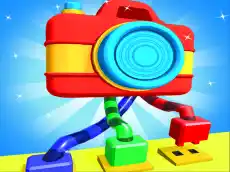
Tangle Fun
Tangle Fun is a logic-based puzzle game that challenges your spatial reasoning as you attempt to untangle complex knots and overlapping lines to clear each level.
About Tangle Fun
This Unity 3D puzzle game focuses on the satisfying process of untangling interwoven elements. Players must use logic and patience to identify which parts to move first, gradually unraveling messy configurations into a clean, organized state. Its visual clarity and straightforward mechanics make it accessible to anyone looking for a mental workout that tests their ability to visualize 3D connections.
The game provides a calming yet stimulating experience suitable for players who enjoy methodical problem-solving. By interacting with the screen using simple mouse or touch controls, you manipulate the scene to resolve the knots. It is an ideal choice for those who appreciate spatial puzzles and the rewarding feeling of turning a chaotic mess into a perfectly ordered arrangement.
- Genre: Logic
- Platform: Browser
- Mode: Singleplayer
- Developer: GamesCreative
- Recommended age: 7+
- Mobile support: Yes
- Release: 03/01/2023
Why players like Tangle Fun
- Satisfying tactile feedback when moving and untangling pieces.
- Clean 3D visuals that make complex puzzles easy to interpret.
- Logical challenges that reward patience and spatial awareness.
- Relaxing gameplay pace suitable for short breaks or longer sessions.
Instructions

How to play
Use your mouse or touch screen to select and drag the tangled components across the board. Observe how the lines or objects are layered to determine the most effective sequence of movements. The objective is to rearrange the pieces until no elements are overlapping or knotted, successfully clearing the stage through careful manipulation of the objects within the 3D space.
Tips for beginners
- Analyze the entire knot from different angles before making your first move.
- Focus on moving pieces that are on the outer edges or the top layer first.
- Utilize open spaces on the board to temporarily store pieces and create more room to maneuver.